Strength Training Made Easy For Normal People
There’s more and more talk about the importance of strength training, but it often seems complicated and daunting.
This is an attempt to simplify and empower people to do it rather than be willing but feel confused, overwhelmed and avoid it.
“Simplicity is the ultimate sophistication"
Leonardo da Vinci
The facts...
1. Principles of strength training
Strength is a measure of the maximal force that can be created. Strength is best thought of as the sound foundation movement is built upon as movement without control is instability.
Principles for getting stronger
Overload It needs to challenge the body to create stimulus for change
Progression As strength increases there needs to be progression of the challenge (often heavier weight)
Specificity It needs to be specific to the movements and goals intended (let’s start with life fit)
Reversibility As quick as you make strength you lose it, this means consistency is key (boom and bust doesn’t work with strength, or most things in life).
Individuality We are all unique case studies of 1 and strength training for you needs to consider you as, well you, not a generic person.
2. Muscle building blocks
You can’t build a wall without bricks. The building blocks of muscle are protein so making sure that this is in abundance will help with strength training.
When it comes to fuel for the body there are three main groups referred to as macronutrients (macros), they are Carbohydrates, Fat and Protein.
Aiming for a protein first diet is a good way which means that you give protein a higher priority than the other two groups. 1.8-2.0 grams of protein per kg of bodyweight is a good figure to aim for.
The increasing popularity to exclude animal products, whilst excellent for reducing your carbon footprint, can result in a deficit of the essential amino acids (building blocks of protein).
There are 9 essential amino acids, essential meaning that your body can’t produce them and they need to be obtained from your diet. They are in plentiful supply in animal products but if excluding these such as in a vegan diet then they need to intentionally included in your diet for good health.
3. Strength training is not bodybuilding
Strength training is often confused with bodybuilding which is a focus on getting bigger (hypertrophy) and this isn’t the same as strength training.
Strength is better thought of as a skill that you are building because a lot of it comes from the body learning how to synchronise and efficiently recruit your muscles rather than just force them to grow which is the aim of bodybuilding.
Consider getting stronger like learning to play the guitar with little and often practice as the best way to do it, rather than massive sessions of playing till your fingers bleed.
What can you do?
Finding something you love or think you’ll learn to love is key. Due to the reversibility effect of strength, consistency is key; you are creating a habit of a lifetime, so it has to be sustainable.
1. Heavy
Throw away the Jane Fonda idea of training with tiny little weights this is more for endurance and the foundation skill you want first is strength. That means a challenging weight usually aiming for no more than 5 repetitions (reps) unless doing a Kettlebell Swing where the number can be doubled to 10.
Commonly, people aim for 8-12 reps, but this is again getting confused with bodybuilding and hypertrophy training.
3-5 reps with a weight that feels challenging but doesn’t scare you is the aim.
2. Fast
We want strength to help with real life and as discussed in Power to the People power is what prevents falls and keeps you safe.
Not every exercise has to be fast but a focus on quick recruitment is what trains your ability to reactive rapidly.
3. Uncomplicated
Gyms have lots of complicated machines and classes and they aren’t needed.
Three movements, 10 minutes a day at home with a kettlebell is enough to get and stay really strong.
Kettlebells are fabulous as they are a doorstop when not being used and are probably the most versatile tool for building strength.
Sample strength program to get and stay strong
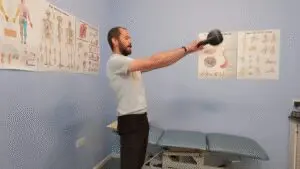
1. Kettlebell Swing
Kettlebell swing, this is a Swiss Army Knife for strength training as it involves the whole body and combines heavy and fast together in one exercise. It specifically trains a powerful hip hinge and the posterior chain of muscles and single handed ones are great core and hip stabiliser muscle workouts.
2. Goblet Squat
Being able to squat down is a foundation movement and this will build your strength in this movement in a comfortable way without having to put bars on your back.
3. Turkish Get-up
My favourite strength exercise, it’s the Yin to the kettlebell swings Yang. Slow, controlled, really building strong arms whereas the arms are relaxed and the movement fast during a kettlebell swing.
This really trains mobility and being able to have lots of tension in your shoulder and arm whilst staying relaxed below.
Fun additions or substitutes for Turkish get up if too challenging
1. Kettlebell Push Press
Great way to train your body working as a unit to push a weight above your head.
Practice the legs starting and driving the movement and the arm just finishing it off.
2. Kettlebell Floor Press
Strong arms and chest muscles are trained in a simple way using the floor press, this is also the starting position for the Turkish Getup so along with the Push Press a great introduction and warm up.
What Kettlebells to get (rough guide)
Men
Aim to start with a 12 or 16 kg kettlebell and work up to 24-32kg
Women
Aim to start with a 8 or 12 kg kettlebell and work up to 16-24kg
Where to get Kettlebells
Decathlon
Good entry kettlebells and what we have in the clinic. Click here…
Wolverson (my fav)
Traditional, original style based on Soviet design from the 1700’s. Click here…
Just do
Getting started is the hardest part so pick 2-3 from above and have a go and then keep the kettlebell somewhere obvious and easy to access and build the 10 minute a day habit and focus on consistency rather than intensity.
See where you are in 2-3 months and that’s how simple strength training can be.