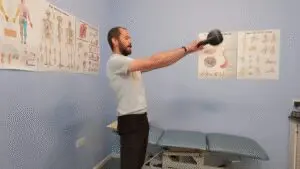
Backs are strong and durable and have evolved to be that way but the modern world is messing that up.
Back pain is the leading cause of disability globally and 80% of people will have a real bout of back pain in their life. This has a massive impact on healthcare, days lost at work and more importantly the people in pain because back pain is horrible!
The good news is that it mostly gets better on it’s own with 70% resolving in a month.
With back pain 10% is due to specific cause. 1% is really nasty stuff like infection, inflammation, fracture and cancer with another 9% being due to major nerve compression and these need immediate attention to best manage. Most are picked up by talking to a healthcare professional rather than needing scans initially.
That leaves 90% of backpain which is called non-specific low back pain and this is by far the most likely thing you have when your back hurts it means that nothing specific can be blamed for the pain, so it’s not just a damaged disc, joint or muscle.
The name irks me as it’s aimed at therapists making sure we move away from the old model of blaming a particular joint or muscle for all the pain, but it gives the person in pain nothing they didn’t already know.
The name in reality is multifactorial back pain and the job of a good therapist is to help the person in pain understand all the factors that are relevant to them because we are individuals and so is your back pain.
Anyone who’s had backpain will know it hurts and stops us from being us, we certainly feel broken but 90% aren’t. The pain is real, absolutely but pain and damage aren’t always closely related.
"When you hear hoofbeats, think horses, not zebras"
The facts...
1. Under stimulated body
As we’ve discussed in our movement article the modern world is under stimulating our body rather than giving it what it needs, lots of varied movement which is sometimes hard.
It’s so easy to go through life in the modern world without all the physically demanding tasks that were needed for survival years ago.
This means squatting, stretching, climbing, lifting and pulling are all done sporadically or not at all. Our body is a pro at efficiency so we need to use it or we lose it, we’re losing it as a society. The average person in the UK spends twice as long on the toilet than being physically active!
So many people hurt their backs doing innocuous movements and whilst a strong, mobile body can’t prevent back pain it certainly helps.
2. Powerful brains
Pain and suffering are related but not the same thing.
Other animals don’t have persistent pain like we humans can and some of that is due to our super impressive brains.
Whilst they can do so many incredible things there’s also a downside. With our ability to think, analyse, predict and create emotions out of this ability we are far more prone to repeated bouts of psychological stress which is almost seen as normal in the modern world.
Being in pain isn’t nice and it’s full of uncertainty about what will happen and often cuts us off from our usual coping strategies, when we need them most they are decreased by our restricted movement and pain which can be exhausting and constantly on our mind.
This causes anxiety around our back pain as we are worried about it not getting better, happening again, losing our independence and lots of other completely understandable fears.
3. Societal fear mongering
Despite actually being strong, robust parts of our body that are perfectly capable of lasting a lifetime the widely held belief is that they are fragile and we need to be careful with them.
How many people have horror stories to tell about someone they know who had a bad back and it was the end of them.
Discs, the dreaded discs, are thought of as delicate things that you absolutely don’t want to have a problem with. Slipped discs, prolapsed discs, degenerative disc disease all this sounds horrible and serious stuff.
Well 90% of 60 year olds without pain have degenerative disc disease, so we may as well call wrinkles degenerative disease of the face because they are just as normal.
If I’m being generous I like to think this is because we can all access information far more easily now so Dr Google is a only a click away.
The cynic in me thinks it’s more because fear sells and there’s a massive industry built up around back pain and the more serious and dangerous it sounds the more silver bullets and lifelong treatment plans can be sold.
We’re also far more likely to pay attention to the worst case scenario when in pain.
Not knowing what has happened or why, coupled with the readily available and societal norms of how bad back pain is feeds our powerful brains more to worry about which makes moving even harder because we don’t know what it is and we certainly don’t want to make it worse.
What can you do?
1. Move because you can, not because you have to
Our body’s love to move, it’s what they are for so finding ways to move whilst staying relaxed in lots of varied ways is a great way to get our body all working together as a unit.
Sedentary lives which the modern world encourages more and more get our body to work in silos rather than as a dynamic unit with everything involved because it’s more efficient. So we sit at our desk or potter around and most of our big muscle groups aren’t really involved in how we move.
What this looks like if you put a muscle activity monitor on someone with an average sedentary life is their back muscles are working overtime constantly switched one and active trying to control and power lots of movements such as bending, twisting and even sitting and our big powerful muscles like the hamstring, glutes and abdominal wall are not given enough stimulation to join in and share the work.
Start slowly and reclaim big movements such as squatting, lunging, twisting as it will wake up the bigger muscle groups and feel good!
2. Unplug and connect with what matters
Knowing what matters to us and making sure we consciously use our powerful brain to focus on not losing sight of this is something valuable in a modern world that’s built on consumerism.
Consumerism, which to my mind is powered by the belief that things can make you happy, is a hollow promise, there are always more things out there and we adjust our baseline almost as fast as we manage to get more so it’s never enough.
Why not try consciously swapping consumerism for the following.
People, building deep meaningful relationships around shared values.
Nature, enjoying being out in it and in awe of how amazing it is. A walk being present with nature is a great tonic to the busy modern world.
Self care, spending time listening to music, dancing, reading, writing, meditating, cooking, exercising. Whatever it is that floats your boat is a great way to look after our mental health and remember you have to put your own oxygen mask on first.

3. Get evidence based facts, not hearsay or scaremongering ones
Beliefs are stubborn, especially the ones that run deep but one of the biggest and underappreciated parts of learning is not about the new information but about letting go of the old belief.
Fear sells and this is why scary ideas have propagated when it comes to backs.
Pain is fundamentally a warning system, it’s warning us about actual or potential damage. Telling the difference between actual or potential is where our body can struggle and we often adopt a better safe than sorry approach and choose avoidance when in doubt which means we move less.
Definition of Pain – International Association For The Study Of Pain 2020
An unpleasant sensory and emotional experience associated with, or resembling that associated with, actual or potential tissue damage,
and is expanded upon by the addition of six key Notes and the etymology of the word pain for further valuable context.
- Pain is always a personal experience that is influenced to varying degrees by biological, psychological, and social factors.
- Pain and nociception are different phenomena. Pain cannot be inferred solely from activity in sensory neurons.
- Through their life experiences, individuals learn the concept of pain.
- A person’s report of an experience as pain should be respected.
- Although pain usually serves an adaptive role, it may have adverse effects on function and social and psychological well-being.
- Verbal description is only one of several behaviors to express pain; inability to communicate does not negate the possibility that a human or a nonhuman animal experiences pain.